The AI Chatbot Is No Longer a Support Tool It's an Operational Layer
How forward-thinking DTC brands are deploying AI chatbots not just to answer questions, but to run entire operational workflows in real time.
Customer expectations in ecommerce have never been higher, or less forgiving. Shoppers want instant answers, frictionless returns, and proactive communication, all without waiting in a queue. Yet most brands are still staffing support desks that operate on business hours, triaging the same repetitive queries day after day.
The traditional response was to deploy a chatbot. But the chatbots of 2019, rigid decision trees, keyword matching, copy-pasted FAQ responses, made customers feel more frustrated, not less. A lot of brands got burned, declared the technology overhyped, and moved on.
That was a different era. Today's AI chatbot for ecommerce is a fundamentally different product. It connects to your backend, understands context, executes actions, and operates around the clock without a human in the loop. The most sophisticated implementations aren't just answering questions, they're doing the work.
This post breaks down what that actually means operationally: what's changed technically, how modern chatbots integrate into ecommerce infrastructure, and why the brands getting ahead are treating AI not as a support feature, but as a core operations layer.
What is an AI Chatbot in E-commerce Today?
Let's be precise about what we mean, because the term "chatbot" carries a lot of legacy baggage. The modern AI chatbot for e-commerce is built on large language models (LLMs) combined with natural language processing (NLP), contextual memory, and deep system integrations. That's a significant departure from rule-based bots that followed scripted trees.
From scripted to conversational intelligence
Where legacy bots matched keywords to canned responses, NLP-powered AI chatbots interpret intent. A customer who types "I haven't gotten my package and I'm leaving for a trip Friday" isn't asking about shipping policy they are communicating urgency. A contextually intelligent system picks that up and responds with real-time tracking data, proactive escalation if the parcel is delayed, and an option to initiate a claim, all within the same conversation.
Modern chatbots also maintain context across a session. They remember that earlier in the conversation the user mentioned they ordered two items, so a follow-up question about a return doesn't require starting from scratch. This sounds simple, but operationally it's the difference between a customer completing a task in two minutes or abandoning in frustration.
More importantly: today's AI in ecommerce is not read-only. The most capable systems don't just retrieve information, they take action.
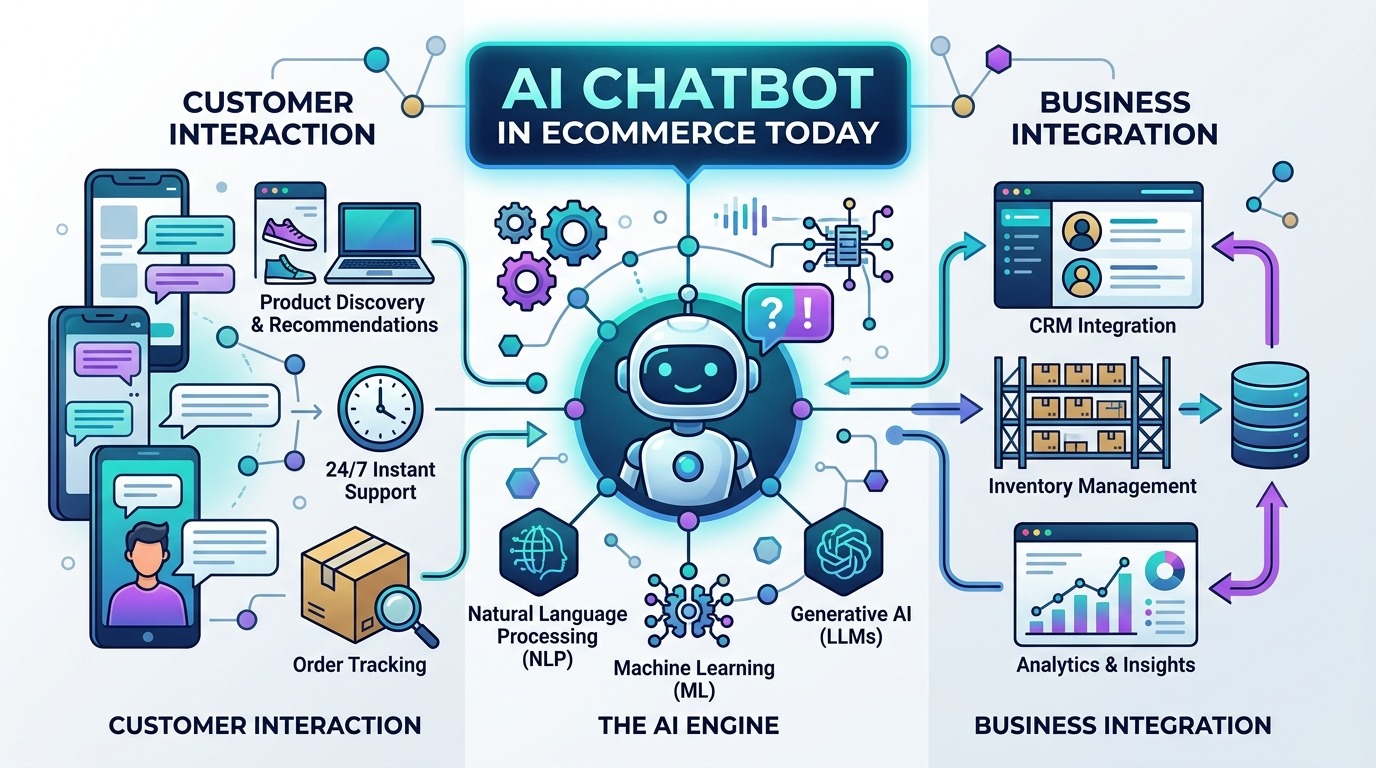
From Support Tool to Operational Layer
The real leap forward isn't in conversational quality, it's in integration depth. An AI chatbot that can talk to your customers but can't talk to your systems is still just a fancy FAQ. The game-changer is when the chatbot becomes a connected node in your operational stack.
What "Connected" actually means
A properly integrated Shopify AI chatbot communicates with your:
- Storefront and OMS to pull live order status, confirm item availability, apply discount codes, and process modifications
- Warehouse and WMS to flag fulfillment delays before the customer even asks, and trigger operational alerts
- Shipping carriers to retrieve live tracking events, estimated delivery windows, and exception statuses from FedEx, UPS, DHL, and others
- Helpdesk platforms to log conversations in Gorgias, Zendesk, or Re:amaze and escalate to human agents with full context attached
- Returns and reverse logistics tools to initiate RMAs, generate return labels, and trigger refund workflows in Loop Returns, Returnly, or custom systems
When these integrations are in place, a single customer conversation can span inquiry, resolution, and operational execution without a human touching it. That's ecommerce operations automation in its most practical form. The shift isn't from bad chatbot to good chatbot. It's from chatbot-as-channel to chatbot-as-infrastructure a layer that executes operations, not just communicates about them.
Key Capabilities of a Modern AI Chatbot
- Intelligent conversation
Intent detection, contextual memory, and nuanced language understanding across sessions
- Real-time execution
Live order lookups, cancellations, address edits, and refund initiation not just information retrieval
- Post-purchase automation
Handles returns, exchanges, refunds, and delivery exceptions end-to-end without manual touchpoints
- System integrations
Connects with OMS, WMS, helpdesks, carriers, and returns platforms via API
- Performance tracking
Measures containment rate, CSAT, resolution time, and automation rate to surface ops insights
These capabilities compound. A chatbot that handles intelligent conversation but lacks real-time execution is limited. One that has all five creates a self-contained operational loop for the most common post-purchase interactions which in most DTC brands account for 60–80% of total support volume.

Benefits for Ecommerce Brands
-
Reduced manual workload
The most immediate benefit is deflection fewer tickets reaching human agents. But framing it as "deflection" undersells what's actually happening. Properly deployed chatbot automation doesn't push customers toward dead ends; it fully resolves their issues.
-
Faster response times
Customer support automation means zero wait times for the most common queries. A customer initiating a return at 11 PM on a Sunday gets a label in their inbox within 60 seconds.
-
Improved customer experience
Customers prefer getting answers immediately over waiting. A contextually intelligent, action-capable chatbot outperforms a slow, inconsistent human response.
-
Scalable operations
Seasonal spikes like Black Friday or flash sales are handled effortlessly. The chatbot scales from 500 to 5000 conversations without performance drop.
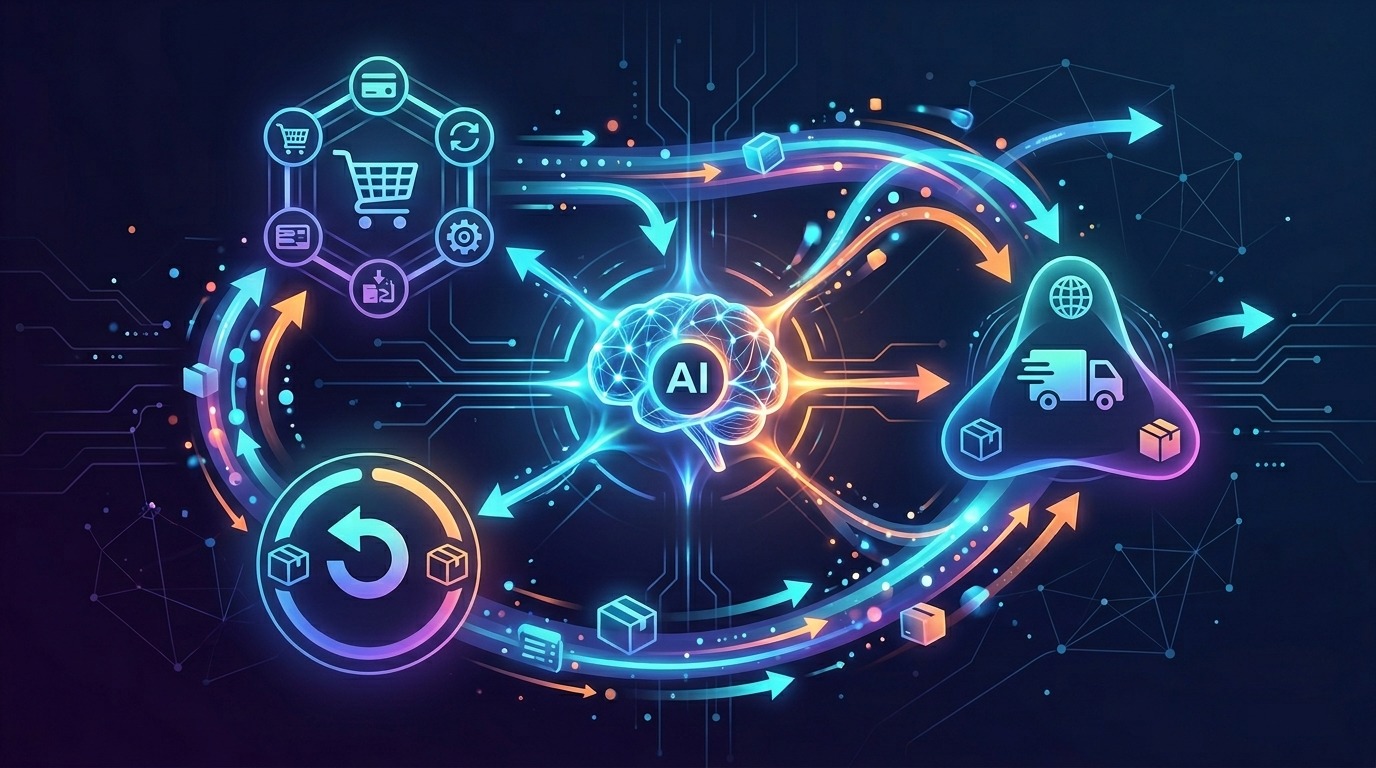
Use Cases: What This Looks Like in Practice
- Use case 01- Order tracking automation
Real-time tracking, delivery estimates, and exception alerts handled instantly.
- Use case 02- Returns and refunds handling
Automated returns, label generation, and refunds without human touch.
- Use case 03 - Customer query automation
Handles product queries, discounts, and subscriptions with full context.
- Use case 04 - Operational alerts and anomaly detection
Detects fulfillment issues, return trends, and operational risks early.
The Future of Ecommerce Operations
AI is shifting ecommerce from reactive to proactive operations.
Systems will anticipate issues, notify customers early, and trigger internal alerts before problems escalate. Shopify ecosystem is evolving fast with AI integrations and automation tools. Winning brands will treat AI as infrastructure, not just a feature.
Closing Thoughts
The real question is not whether to use AI, but how deeply it is integrated. A well-built AI operational layer improves speed, consistency, and scalability. Brands adopting early will build a long-term competitive advantage.
Newsletter to recieve
our latest company updates
Comment